Carer period
Never Let Me GoThe Carer period is the stage of the Donation Programme in which students care for Donors as they recover and continue through successive donations. It is at once a demanding form of work and a framework for intimate relationships: carers offer practical and emotional support, while their own lives are shaped by travel, solitude, and the prospect of eventually becoming Donors themselves. For Kathy H., the period lasts almost twelve years and brings her back into contact with Ruth and Tommy, making professional care inseparable from personal memory and attachment.
Identity and Structure
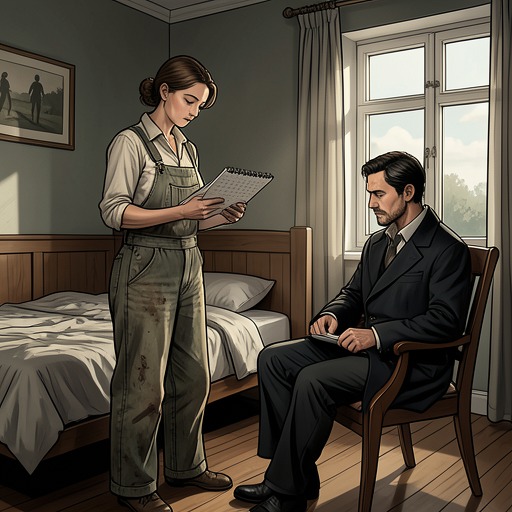
The Carer period is defined by the relationship between a carer and the Donor or Donors in their care. Carers accompany people through recovery and provide attention that can include listening, offering comfort, allowing privacy, and speaking up for them in hospital. The phase does not remove the uncertainty surrounding the Donation Programme: carers can support recovery, but they cannot guarantee its outcome or know with certainty what completing a donation means.
Kathy is thirty-one when she describes having worked as a carer for more than eleven years, with another eight months expected before the end of the year. That would bring her tenure to almost exactly twelve years. Her account presents the work as an extended life stage rather than a brief assignment. Carers may eventually be told to stop and become Donors; the length of service varies, and a long tenure does not by itself prove exceptional ability. Kathy knows of carers who were released after two or three years and one who served fourteen years despite, in her view, being unsuited to the work.
Work, Skill, and Isolation
Kathy takes pride in the quality of her care, while acknowledging that her Donors’ recovery times and relative calm are not solely a measure of her own merit. She describes developing an instinct for when to stay and comfort someone, when to leave them alone, when to listen, and when to be more direct. Her approach depends on responding differently to different needs rather than applying a single manner to every Donor. She also values the ability to make her voice heard in hospital and to advocate when necessary, a contrast with carers who feel unable to speak to medical staff on a Donor’s behalf.
The work can be emotionally wearing. A Donor may fail to recover as expected, and reassurance from nurses or a letter praising a carer’s effort does not necessarily prevent demoralisation. Kathy recognizes that some carers never learn to manage such losses. She also describes the pressure of prolonged closeness to pain and worry, and the frustration that follows when events go badly despite a carer’s efforts. Her confidence is therefore not an assertion of control over outcomes: it rests on being able to feel that she has done what she could and to keep events in perspective.
The role also isolates carers from the crowds and familiar company of earlier life. Kathy describes long drives from centre to centre and hospital to hospital, overnight stays, broken sleep, and too little time or energy to talk with a familiar carer or Donor when they happen to meet. The accumulated strain becomes visible in posture, gaze, movement, and speech. Yet solitude has a more complicated place in her experience: she has learned to enjoy driving alone with the roads, grey sky, and daydreams for company, and likes browsing shop windows during spare minutes. Her four matching desk-lamps, each with a bendable ribbed neck, give her another quiet point of interest; she sometimes looks for similar lamps in shop windows simply to compare them with her own.
Choice, Memory, and Relationships
During the first six years of her work, Kathy is not allowed to choose which Donors she cares for; later, she can choose. She understands why the privilege may cause resentment, especially when other carers believe she favors people from Hailsham or similarly privileged backgrounds. She does not claim that she has cared only for people from those places, and notes that she has worked with Donors from varied upbringings. Still, choosing familiar people matters to her: care becomes harder when there is no deeper connection, and she believes she could not have continued for so long if she had stopped feeling for the Donors in her care.
Ruth is only the third or fourth Donor Kathy chooses. Ruth already has an assigned carer, so Kathy must find the nerve to arrange the change. When they meet again at the Dover recovery centre, their past differences remain, but their shared childhood at Hailsham and their common memories matter more. From then on, Kathy increasingly seeks out people from her past, especially those from Hailsham. The decision to become a carer thus opens a route back into relationships that time and conflict had interrupted; it does not erase those conflicts.
The eventual decline of Hailsham sharpens the meaning of that reconnection. After hearing from Roger that Hailsham has closed, Kathy reflects that plans she assumed could wait may have to be acted on soon or abandoned. The news changes her sense of time and helps explain why Laura’s suggestion that she become Ruth’s carer has such force, even though Kathy initially resists it. Within weeks, Kathy visits Ruth after her first donation. Their reunion begins warmly, with conversation about Hailsham, the Cottages, and their intervening lives, but they initially avoid discussing the way they parted. The renewed relationship is therefore hopeful without being simple.
Later Years and Significance
As the number of Donors Kathy remembers diminishes, she finds herself choosing less often. The work becomes harder when she lacks a personal bond with the person she is caring for, and she is ready for her carer tenure to end. Her later work with Ruth and Tommy makes the difference between professional responsibility and private attachment especially clear. After Ruth’s second donation, Kathy sits beside her for hours, holding her hand. When Ruth briefly recognizes her, Kathy promises to become Tommy’s carer as soon as she can. The promise connects a practical change of assignment to Ruth’s wish and to Kathy’s continuing ties with both of them.
The period also exposes the limits of what carers and Donors can know. Around Tommy’s fourth donation, he raises the fear that no one knows for certain what completion entails. Donors may be treated with special respect when they reach a fourth donation, but that public recognition coexists with uncertainty about whether completion is final and what might follow it. Kathy dismisses his concern rather than discussing it, then recognizes that she has no evidence with which to reassure him. The exchange shows how care can involve presence and loyalty without resolving the questions that the system leaves unanswered.
Tommy later asks whether Kathy ever wishes she would receive notice to stop being a carer, since the others became Donors long ago. Kathy answers that good carers matter and says she is a good carer; Tommy questions whether the role changes the eventual fact that Donors donate and complete. Their conversation brings the period’s central tension into focus: care makes a meaningful difference to how people are accompanied, listened to, and supported, but it cannot cancel the course set by the Donation Programme. Kathy’s long service is presented both as skilled labor and as a form of sustained human connection within that constraint.